
Out & About
The Right to Pee: Bengaluru Says Yes, but Can You Actually Go?
When nature calls, should you have to buy a coffee just to use the restroom? Bengaluru has been talking about public toilet access for years. But a recent audit raises a more pressing question: even when you find a toilet, can you actually use it?

Picture this. You're somewhere in Bengaluru, caught between a traffic jam, an afternoon of errands, and a bladder that has officially stopped negotiating. You spot a café. Salvation! Except there's one small problem: you're not a customer.
Do you walk in and ask politely? Buy a coffee you don't particularly want? Pretend you're meeting someone inside? Or continue your increasingly desperate search for a public restroom?
It's a ridiculous situation when you think about it. Going to the toilet is a basic human necessity, yet finding somewhere to do it in a city of millions can feel like an elaborate treasure hunt. Except the treasure is a functioning toilet, and you're running out of time.
Bengaluru's civic authorities have acknowledged the problem. There have been proposals to open restaurant and hotel toilets to the public, plans for additional facilities, and government directions concerning restroom hygiene. But a 2026 audit suggests that the city's sanitation problems run much deeper than simply finding a door marked Toilet.
When Bengaluru Said Toilets Should Be for Everyone
In January 2024, the Bruhat Bengaluru Mahanagara Palike (BBMP) submitted a status report to the Karnataka High Court outlining measures intended to improve public access to toilets.
Among these was a proposal to allow members of the public to use restrooms in restaurants and hotels, regardless of whether they were customers. BBMP also proposed opening toilets at 172 Indira Canteens for public use and constructing 100 women-exclusive SHE toilets. The civic body had directed senior health officials to take the necessary steps and issue relevant orders or circulars concerning access to restaurant and hotel facilities.
The developments were reported by The News Minute and Business Standard.
On paper, the idea makes sense. Restaurants, hotels, and cafés already have toilets, while public facilities are not always available where people need them. Allowing broader access could help bridge that gap.
However, there is an important distinction between a proposal and an enforceable requirement. The January 2024 reports establish what BBMP told the High Court it intended to do. They do not independently establish that every restaurant in Bengaluru is currently legally required to admit noncustomers.
That distinction matters, especially when someone is standing outside a café wondering whether they can use its restroom without ordering a sandwich.
A Government Advisory Is Not Quite the Same Thing
In August 2026, Karnataka's Food Safety and Drug Administration issued a 12-point advisory to food establishments, including hotels, restaurants, and catering businesses, addressing food safety and hygiene requirements.
The advisory included directions concerning clean toilets, adequate water, and handwashing facilities for staff and customers. It also covered broader food-safety practices, including cleanliness, pest control, and safe food handling.
These requirements are important. A restaurant toilet that exists but lacks water, soap, or proper maintenance is hardly a reassuring option for anyone.
However, the 2026 hygiene advisory and BBMP's earlier public-access proposal address different questions. One concerns the condition and availability of facilities for customers and staff; the other concerns access for people who are not customers.
The available reporting does not conclusively establish a blanket, enforceable right for every passerby to use every private establishment's toilet without making a purchase.
And that brings us to another problem: what happens when the public toilets that are supposed to serve everyone aren't functioning?
One in Four Public Toilets Doesn't Work
In July 2026, the Bangalore Political Action Committee (B.PAC) released findings from a citizen-led audit of 142 public toilets across Bengaluru. The survey, conducted in April and May, examined functionality, hygiene, accessibility, safety, and the overall user experience.
The findings were troubling.
Of the 142 toilets surveyed, 37 were completely non-functional. That's 26 percent, or slightly more than one in four. Only six facilities, representing 4.2 percent of the sample, were rated very clean, while 58 percent had persistent foul odours.
Adequate lighting was available in only 56 percent of the toilets surveyed. Just nine had ramps, and only around 40 percent of functioning toilets had water available. None of the surveyed facilities had soap dispensers or dustbins.
These findings were reported by The Indian Express, NDTV, and Deccan Herald.
The figures describe the toilets included in the audit, rather than every public toilet in Bengaluru. Nevertheless, they expose serious maintenance and accessibility problems in the facilities examined.
A toilet without water is a problem. A toilet without a functioning lock can be a safety concern. A toilet that someone using a wheelchair cannot enter is not meaningfully accessible to that person.
And a toilet that doesn't work is, well, not much of a toilet at all.
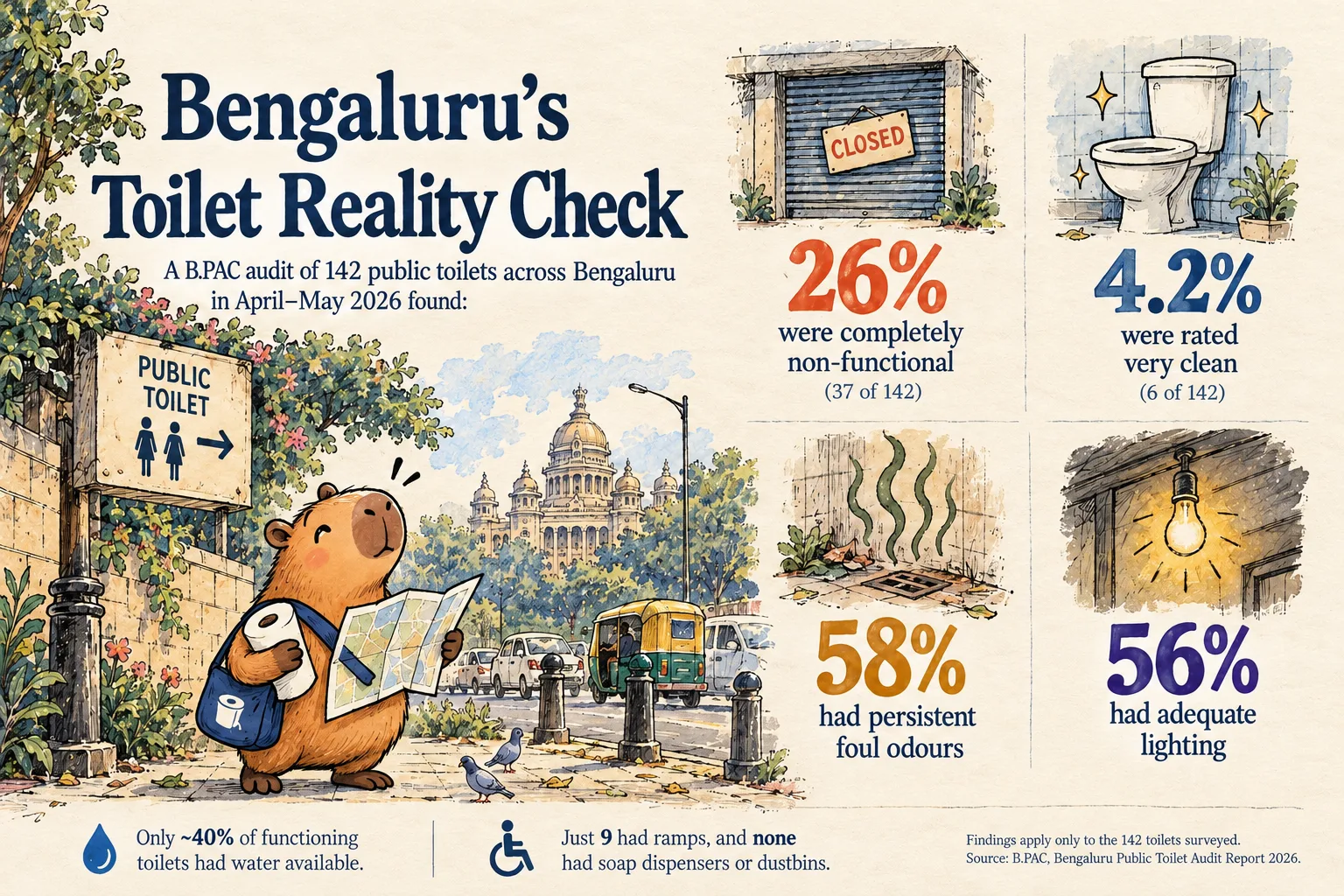
Bengaluru's public toilet reality check. Findings from B.PAC's April–May 2026 audit of 142 public toilets. Water availability was measured among functional toilets. Source: B.PAC, Bengaluru Public Toilet Audit Report 2026.
Why This Matters Beyond an Inconvenient Bladder
For some people, finding a toilet is an inconvenience. For others, the absence of a safe, accessible facility can influence whether they leave home, how long they stay out, or which routes they take.
Consider women managing menstruation, parents accompanying young children, pregnant women, older adults, people with disabilities, or anyone living with a medical condition that makes restroom access urgent.
These are not exceptional circumstances. They are ordinary parts of everyday life.
Poor sanitation can also create health concerns. In reporting by Bangalore Mirror, medical professionals highlighted the difficulties women face when toilets lack water, privacy, adequate lighting, or facilities for menstrual hygiene. They also discussed the potential consequences of repeatedly delaying urination because suitable facilities are unavailable.
And the problem extends beyond the toilet itself. A parent may find a clean restroom but nowhere suitable to change a diaper. A nursing mother may find a shopping complex but no comfortable feeding space. A person with limited mobility may locate a public toilet only to discover steps at the entrance.
Accessibility is not simply about putting a facility on a map. It is about whether someone can realistically use it.
More Toilets, or Better Toilets?
According to B.PAC's 2026 report, Bengaluru has an estimated 800 to 900 public toilets for a population exceeding 1.4 crore, with 479 officially listed under the Greater Bengaluru Authority (GBA).
The organisation estimated that this amounts to roughly one public toilet for every 25,000 to 30,000 residents. It recommended constructing more than 1,000 additional public toilets, particularly in high-footfall locations such as transport hubs, markets, parks, tourist destinations, and construction sites.
But building new toilets is only part of the answer.
B.PAC also recommended an emergency repair campaign for non-functional facilities, improved maintenance contracts, accessible infrastructure, and a dedicated public toilet management cell.
The logic is straightforward. Building a toilet creates infrastructure. Keeping it clean, safe, supplied with water, and open to the public makes that infrastructure useful.
The same principle applies to opening restrooms in private establishments. Clear rules, reasonable operating conditions, and consistent implementation matter if a public-access policy is to work for visitors and businesses alike.
So, Can You Walk Into a Restaurant and Pee?
Here's where things stand.
BBMP's January 2024 proposal supported allowing the general public to use restaurant and hotel toilets, even without being customers. Karnataka's August 2026 food-safety advisory addressed the cleanliness and availability of toilet facilities for customers and staff.
But the available sources do not establish that everyone currently has an unconditional legal right to use any restaurant or café restroom without purchasing anything.
You can certainly ask. And establishments may choose to accommodate you. But it would be misleading to promise that every business must allow access under all circumstances.
In the meantime, the larger responsibility remains with civic authorities and other stakeholders to ensure that people have access to sufficient, functioning, hygienic public sanitation facilities.
Because when nature calls, nobody should have to start researching municipal regulations while crossing their legs.
The Right to Pee Shouldn't Come With a Receipt
Bengaluru is a city of technology parks, cafés, shopping malls, bustling markets, and endless construction. Yet something as basic as finding a clean, usable toilet can still require careful planning, local knowledge, and a little luck.
The debate over public access to restaurant toilets is important. So is the condition of the facilities the city already has. Neither problem can be solved by announcements alone.
At Pee-Pee, we're working to make the search a little easier by helping people discover restrooms, baby-changing facilities, and nursing or feeding spaces around Bengaluru. Through The Loo-Down, people can also share their experiences and help others make more informed decisions about where to go.
Facilities, access, and availability cannot always be guaranteed. But better information is a useful place to start.
Because the right to pee shouldn't depend on the price of a cappuccino.
And when you've gotta go, you've gotta go.
References & Sources
- Bangalore Political Action Committee (B.PAC). Bengaluru Public Toilet Audit Report 2026 Accessed 2026-10-31.
- The Indian Express. 1 in 4 Public Toilets in Bengaluru Non-Functional: Report Accessed 2026-10-31.
- The News Minute. Restaurants, Hotels in Bengaluru Will Have to Allow Toilet Access for All: BBMP Accessed 2026-10-31.
- Business Standard. Public to Be Allowed to Use Toilets in Restaurants in Bengaluru: BBMP Accessed 2026-10-31.
- Bangalore Mirror. No Room for the Ladies Accessed 2026-10-31.