
Out & About
The Great Indian Bathroom Queue
Why do women face longer restroom queues while men's facilities seem to move faster? Research reveals how unequal capacity, conventional architectural layouts, and overlooked user needs contribute to the great bathroom queue, and why better public toilet design matters in India.
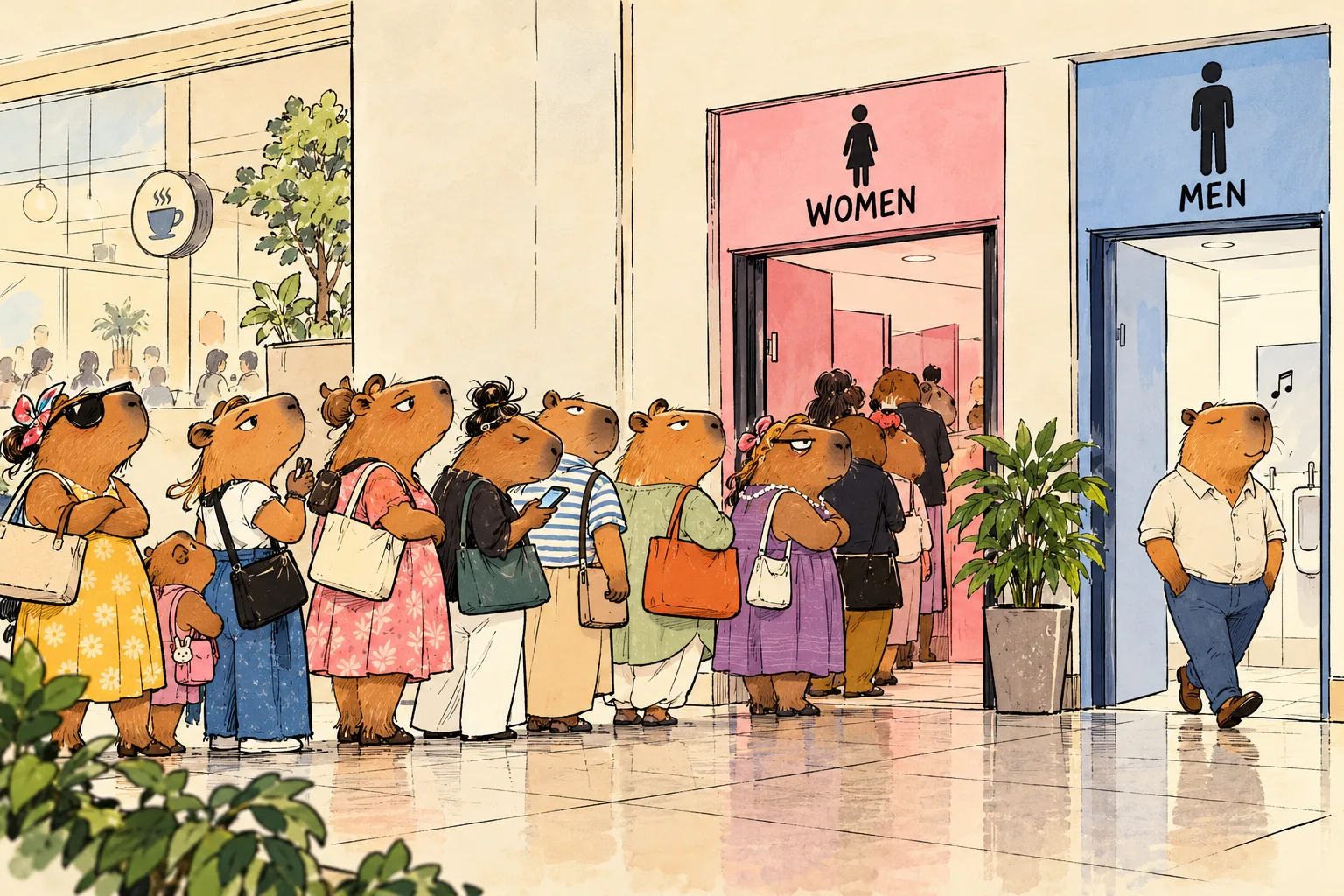
Ladies First. Eventually.
If you've ever stood outside a women's restroom in a mall, airport, theatre, or restaurant, you know the scene. There is a queue. Sometimes a manageable one, sometimes a queue so long that you begin questioning your decision to drink that second coffee. Meanwhile, men appear to operate on an entirely different timeline. They walk in, walk out, check their phones, and ask why you're taking so long. It is a familiar irritation, frequently dismissed as one of those unavoidable differences between men and women. But the queue outside the women's restroom is not simply an unfortunate fact of life. It is often a consequence of how public toilets are designed, and there is considerable research behind this particular bathroom grievance.
Equal Space Does Not Mean Equal Access
Imagine designing a shopping mall with roughly equal floor space allocated to men's and women's restrooms. Both facilities occupy similar areas, have separate entrances, and appear balanced on the architectural plan. At first glance, that seems perfectly reasonable. However, equal floor space does not necessarily provide equal access, particularly when the fixtures and patterns of use differ significantly. Men's restrooms typically combine urinals with enclosed toilet cubicles, allowing more fixtures to fit within a given space. Women's restrooms generally rely entirely on enclosed cubicles, which require more floor area and accommodate fewer users at a time. The result is a difference in capacity that can become particularly pronounced during busy periods.
This problem has a name: potty parity. The concept focuses on equitable access to restroom facilities rather than simply providing identical space or fixture allocations. A 2019 study published in Socio-Economic Planning Sciences, titled The Potty Parity Problem: Towards Gender Equality at Restrooms in Business Facilities, used queueing theory and simulations to examine differences in waiting times. The researchers found that conventional standards, including the Uniform Plumbing Code provisions examined in their analysis, could fail to deliver equal access even when facilities complied with prescribed requirements. Their findings highlight an important distinction between providing comparable facilities on paper and ensuring that users experience comparable waiting times in practice.
The issue is not necessarily that architects deliberately ignore women's requirements. Restroom layouts are shaped by building codes, available floor area, budgets, fixture requirements, and operational considerations. However, when design decisions prioritize conventional allocations without adequately accounting for demand and usage patterns, unequal waiting times can become an unintended but predictable consequence. A symmetrical floor plan may look efficient, yet the experience of using the facilities can be anything but balanced.
Why Women Often Spend Longer in Restrooms
The usual explanation for longer queues is that women simply take more time. While differences in usage duration can contribute to waiting times, the reasons are considerably more complex than the familiar jokes about women taking forever. Menstruation, pregnancy, clothing adjustments, personal hygiene, and the need to assist children or dependent relatives can all influence how long someone requires a restroom. Women also generally rely on enclosed cubicles for every visit, whereas men may have access to urinals for some uses. Privacy, available sanitary disposal facilities, and the condition of the toilets themselves can further affect how efficiently a restroom operates.
A 2026 study titled Beyond “Potty Parity”: Public Toilets, Gendered Time Costs, and Institutional Accountability in Everyday Mobility examined restroom use and the consequences of differing usage times. In one university setting, researchers observed 24 male and 32 female users, finding that women spent somewhat longer in the facilities on average, with a more pronounced difference during peak periods. Although this was a relatively small, location-specific sample, it demonstrated how modest differences in individual usage times can accumulate into substantial queues when demand increases. The research also emphasized that equal numbers of facilities do not necessarily guarantee equitable access.
Another 2026 study, User Preferences on Toilet Features and Layout: Observations from a Homogeneous Sample of Users in a University Building, explored the relationship between restroom layouts, fixture availability, and user experiences. Its findings illustrate why assumptions about gender alone are insufficient to explain waiting times. Actual restroom configuration matters, and usage patterns can vary considerably between facilities. This makes it important to evaluate the number and type of available fixtures, rather than assuming that women will inevitably face longer queues regardless of how restrooms are designed.
When Architecture Meets Reality
A building's restroom facilities may appear adequate until large numbers of people need to use them simultaneously. Consider a theatre during an interval, a crowded wedding venue, a stadium after an event, or an airport terminal before boarding. Demand increases sharply, and small differences in restroom capacity or usage time can produce disproportionately long queues. These are not unusual circumstances. They are entirely predictable patterns of human behavior that can be considered during the planning and design stages.
The question, then, is whether restroom infrastructure should be evaluated primarily by the number of fixtures installed or by how effectively those fixtures serve the people who need them. A facility with several cubicles may appear sufficient under a conventional allocation formula, but its practical capacity falls when some toilets are unavailable, locks are broken, water supply is interrupted, or cleaning schedules coincide with peak usage. Inadequate maintenance can undermine even a thoughtfully designed restroom, making the experience considerably worse for users who already face longer waiting times.
Researchers examining potty parity have explored alternatives that include increasing the number of women's cubicles, reconsidering fixture allocations, and introducing appropriately designed shared restroom facilities. The objective is to reduce unequal waiting times without compromising accessibility, privacy, or safety. All-gender facilities with fully enclosed cubicles may improve flexibility in certain environments, but they require careful planning rather than simply replacing existing signs. Design choices must also accommodate people who need accessible facilities, caregivers assisting someone of another gender, and those who require greater privacy or prefer separate facilities.
India's Public Toilet Problem Goes Beyond Construction
In India, public sanitation discussions have understandably focused on improving toilet availability, expanding infrastructure, and addressing open defecation. These remain essential priorities, but the quality and usability of existing facilities deserve equal attention. Finding a public toilet is only the first challenge. Finding one that is clean, accessible, safe, functional, and suitable for individual needs can be considerably more difficult, particularly for women, children, older adults, and people with disabilities.
India's Harmonised Guidelines and Standards for Universal Accessibility recognize that public washrooms should accommodate people of different ages, genders, and abilities, including caregivers, families with young children, older people, and expectant mothers. The guidelines reflect a broader understanding of accessibility that extends beyond providing separate facilities for men and women. Similarly, a December 2023 response from the Ministry of Social Justice and Empowerment outlined provisions concerning sanitation facilities for transgender people, including unisex toilets within equal opportunity policies. These developments acknowledge that public restroom design must reflect the diversity of people using public spaces.
However, recognizing different needs in policy is only part of the solution. The effectiveness of public sanitation infrastructure ultimately depends on how these principles are implemented, maintained, and monitored. A wheelchair-accessible toilet that is locked or used as a storage room serves little purpose. A baby-changing station accessible only through the women's restroom assumes that childcare is exclusively a woman's responsibility. A restroom without water, functioning locks, or sanitary disposal facilities cannot be considered fully usable simply because it exists on a building's facilities list.
For a city like Bengaluru, these questions are particularly relevant. Residents routinely spend extended periods outside their homes, navigating traffic, workplaces, shopping areas, restaurants, entertainment venues, and other public spaces. Reliable restroom access influences how comfortably people can move around the city, especially when travelling with children, managing health needs, or spending long hours away from home. What appears to be a minor inconvenience during a shopping trip can become a significant barrier to everyday mobility.
Designing for People Rather Than Floor Plans
Addressing unequal restroom access does not require an entirely new understanding of architecture. It requires a more practical assessment of who uses a facility, how often they use it, and what they need when they get there. Building designers and operators can consider expected footfall, peak demand, waiting times, fixture arrangements, privacy requirements, accessibility, and maintenance when making decisions about restroom provision. In some settings, providing more cubicles for women may reduce waiting times. In others, flexible layouts and well-designed shared facilities may offer benefits. The appropriate solution will depend on the building, its users, and the surrounding circumstances.
Equally important is recognizing that restroom infrastructure should not be treated as an afterthought. Public toilets are essential facilities that influence health, comfort, dignity, and participation in public life. Their quality affects whether people feel comfortable spending time in public spaces, particularly when suitable alternatives are unavailable. A thoughtfully designed restroom is not a luxury or a decorative addition to a building. It is part of making that building genuinely usable.
The great Indian bathroom queue has become such a familiar experience that many of us barely question it anymore. Women wait patiently, shuffle forward, exchange sympathetic looks, and hope the next cubicle has a functioning lock. Somewhere nearby, a man emerges from his restroom and wonders why everyone else is taking so long. It is an amusing contrast until we consider how much of that waiting could be reduced through better design and more realistic planning.
We can build increasingly sophisticated airports, enormous shopping malls, modern office complexes, and elaborate entertainment venues. Surely, we can also design restrooms that do not require half their users to develop the patience of a saint. The challenge is not simply to build more toilets, but to build facilities that work for the people who use them.
Until then, the great Indian bathroom queue continues. Ladies first, eventually.
References & Sources
- Socio-Economic Planning Sciences, 2019. The Potty Parity Problem: Towards Gender Equality at Restrooms in Business Facilities Accessed 2026-10-29.
- Laws, 2026. Beyond “Potty Parity”: Public Toilets, Gendered Time Costs, and Institutional Accountability in Everyday Mobility Accessed 2026-10-29.
- Buildings, 2026. User Preferences on Toilet Features and Layout: Observations from a Homogeneous Sample of Users in a University Building Accessed 2026-10-29.
- Government of India. Harmonised Guidelines and Standards for Universal Accessibility in India Accessed 2026-10-29.
- Ministry of Social Justice and Empowerment, December 2023. Separate Toilets for Transgenders in Public Places Accessed 2026-10-29.