
Out & About
Bengaluru, We Need to Talk About Toilets
In a city where almost everything is a tap away, finding a clean, usable restroom can still be an unexpected adventure. From public toilets and accessibility to diaper-changing and nursing facilities, we explore why something so basic remains surprisingly difficult in Bengaluru—and why a little shared local knowledge could make all the difference.
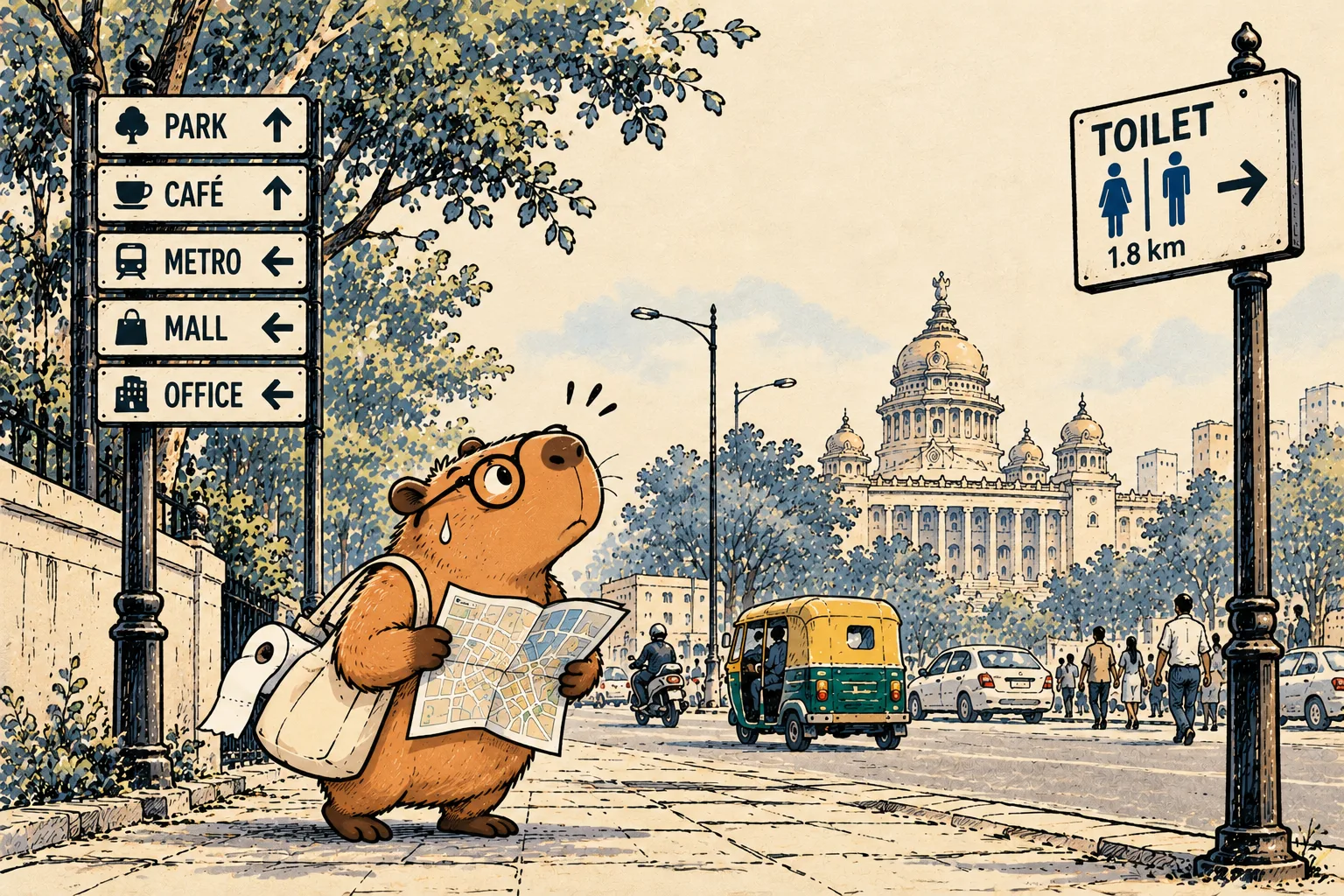
Because finding a decent restroom shouldn't require investigative journalism.
There are few things more humbling than needing a toilet in Bengaluru. You could be stuck in traffic on Outer Ring Road, halfway through a shopping expedition, or enjoying a perfectly pleasant afternoon when your bladder decides it has other plans. Suddenly, the city's traffic, weather, and endless construction are no longer your biggest concerns. All you want is a toilet. Preferably one that is nearby, functional, and unlikely to leave you questioning your life choices.
For a city that has made convenience something of an industry, finding a usable restroom can still be a surprisingly complicated exercise. We can order groceries, book rides, track deliveries, and have almost anything brought to our doorsteps. Yet the simple question of where to find a clean public toilet often requires a combination of local knowledge, optimism, and sheer desperation. A map might tell you where a facility is located, but it cannot always tell you whether it is open, whether there is running water, whether the door locks, or whether you would be better off looking elsewhere.
And therein lies the problem. The existence of a restroom does not necessarily make it usable. Cleanliness, maintenance, privacy, safety, and accessibility all matter, particularly when someone has limited time or few alternatives. A poorly maintained facility is inconvenient for some people and effectively inaccessible to others. For anyone with mobility limitations, a restroom that can only be reached by climbing stairs is not much of an option, regardless of how prominently it appears on a map.
The challenge extends beyond toilets. Parents and caregivers looking for diaper-changing facilities often have little information about where these spaces are available, while people seeking a private place to nurse or feed a baby may find themselves navigating buildings and asking staff for directions. These are ordinary needs, not unusual requests. Yet the information required to meet them is frequently scattered, incomplete, or simply unavailable.
Most of us have developed our own informal systems for dealing with this. We remember which shopping malls have reliable restrooms, which cafés are accommodating, and which petrol stations are best avoided. We exchange recommendations with friends and family, mentally catalogue useful locations, and occasionally discover a surprisingly decent facility that feels like finding buried treasure. This knowledge is valuable, but it rarely travels beyond the people who happen to possess it.
That raises a fairly obvious question: why shouldn't finding a restroom be easier? Not every facility needs a five-star rating or an elaborate review. Sometimes knowing that a toilet exists, that it was reasonably clean during a recent visit, or that a diaper-changing station is available on a particular floor is enough to make someone's day considerably less stressful. Recent experiences can provide useful context, even if they cannot guarantee what another visitor will encounter.
This is the thinking behind Pee-Pee, a Bengaluru-focused website developed by Vayu Labs to help people look for toilets, diaper-changing facilities, and nursing or feeding spaces. Alongside its facility finder, The Loo-Down allows visitors to share observations about individual facilities. The distinction is deliberate. A restaurant might serve excellent food and have a restroom that deserves its own cautionary tale. Reviewing the bathroom should not require reviewing the biryani.
Of course, no directory or community review can promise that a facility will be available or in the same condition when someone arrives. Opening hours change, amenities break, and maintenance standards vary. But making information easier to find, and giving people a way to share what they encounter, is a reasonable place to start.
There is also a broader conversation worth having. Public sanitation, hygiene, accessibility, and the availability of basic facilities influence how people experience a city. They affect everyday decisions about travel, work, shopping, and spending time outside the home. Yet bathrooms remain an oddly neglected subject in public conversation, perhaps because everyone uses them and almost nobody wants to discuss them over dinner.
We intend to discuss them anyway.
Flush & Tell is where we'll explore the practical, peculiar, and occasionally ridiculous aspects of bathroom life. From hygiene questions and popular misconceptions to public facilities and the strange things people believe about toilets, there is considerably more to the subject than most of us would care to admit. Some of it deserves serious attention. Some of it deserves a raised eyebrow. And some of it is simply funny.
After all, the need for a toilet is one of the few experiences that can unite an entire city, regardless of profession, income, or opinion about Bengaluru traffic. We may disagree about almost everything else, but nobody enjoys discovering that the nearest usable restroom is several kilometres away.
Welcome to Flush & Tell. Serious information. Questionable humor.